
Hybrids rely on fossil fuels as a power source and therefore still produce greenhouse gas emissions.
This reliance on fossil fuels means that full hybrids, mild hybrids and plug-in hybrid vehicles offer little emissions savings on traditional ICE vehicles. This is true of both real-world driving emissions and lifecycle emissions.
Research by Transport & Environment has found that over the lifetime of the vehicle (including emissions from manufacturing and generating the fuel or electricity), a new PHEV bought in 2020 will emit 28 tonnes of CO2e and a new full hybrid 33 tonnes. A conventional petrol or diesel car emits 39 and 41 tonnes respectively. A new BEV emits just 3.8 tonnes of CO2e over its lifetime.
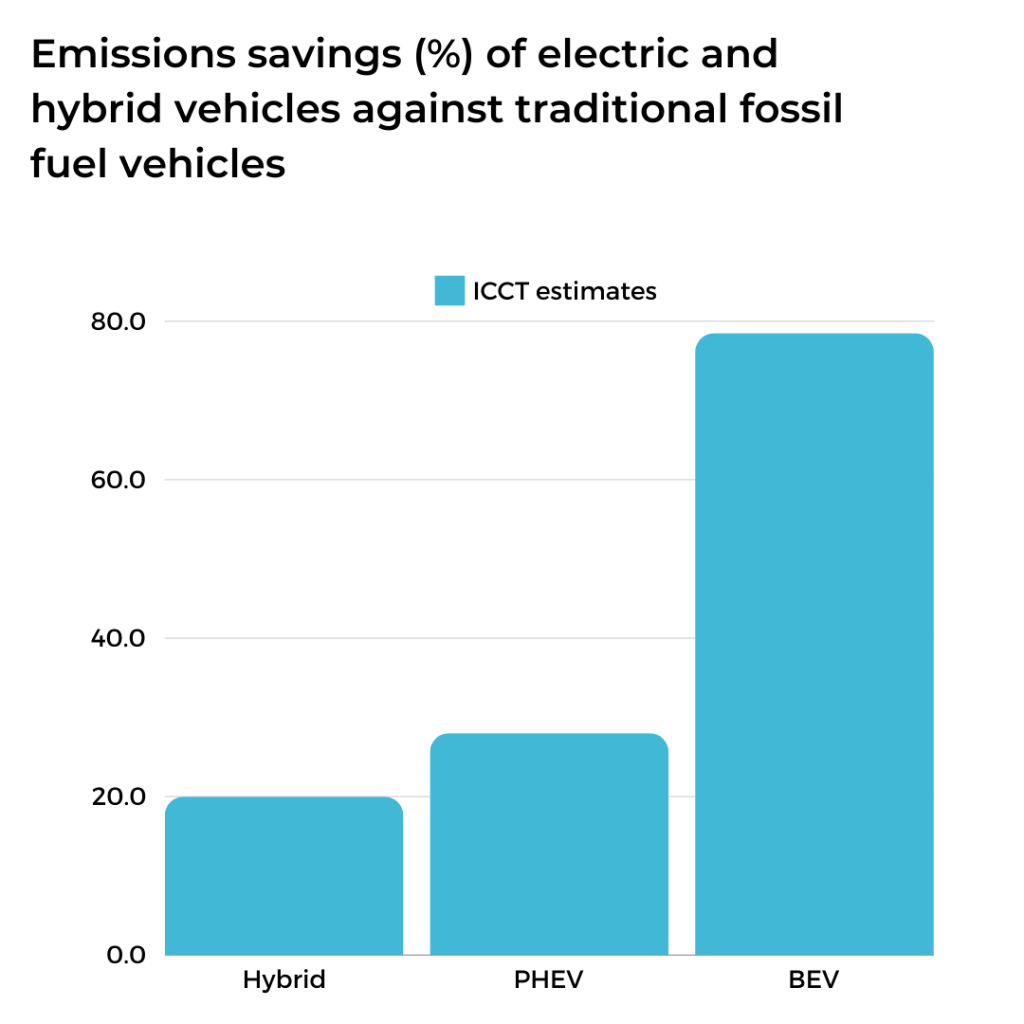
Similarly, research by the International Council on Clean Transportation found that across the EU and UK, lifecycle emissions for full hybrids are on average just 20% lower than comparable ICE vehicles and for PHEVs an average of 25-31% lower. In contrast, lifecycle emissions for BEVs are 63-69% less than comparable ICE vehicles, rising to 76-81% reduction when renewable energy is used to charge the battery.
Hybrid sales
The deficiencies of hybrids haven’t stopped carmakers continuing to make, promote and sell them anyway. The UK’s five biggest carmakers by sales – VW, Ford, Audi, Kia and Toyota – together offered 96 different car models for sale in 2022. Of these, 77 were available with petrol and diesel engines and 56 with hybrid engines. Just 15 were available as battery or fuel cell EVs.
When it comes to sales, Kia had the highest rate of battery EV sales at 16.3% whilst Toyota had both the lowest rate at 0.4% and the highest proportion of full and mild hybrid sales 74.4%.
 ElectriLIED